Sometimes feelings or experiences can be so painful, so traumatic, that to survive, you shut them down and attempt to block them from your awareness. When I first saw my surgery scars in the mirror, I remember saying to myself, forget about them, don’t look, ignore it and you won’t have to feel it. It was too upsetting to focus on the ways my body and life were changed.
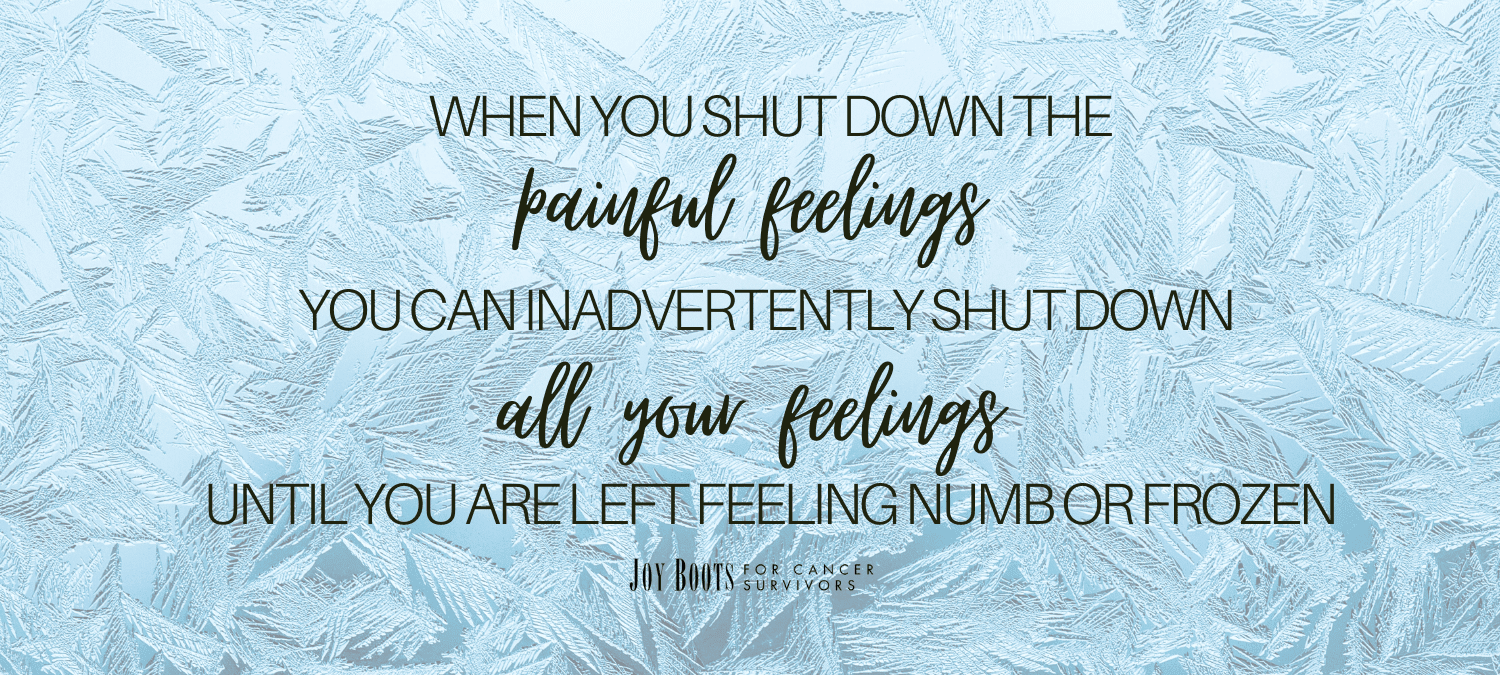
But what I discovered from my own life and from talking with hundreds of cancer survivors, is that when you “shut down” the painful feelings, you can inadvertently shut down ALL your feelings, until you are left feeling “numb” or “frozen.”
PTSD can make it hard to feel loving feelings, pleasure in the things you enjoy, and even anger can be muted. In the process of protecting yourself from pain, all the feelings can become muted or shut off. And when this happens, you lose access to life force energy and important information about what you want from life and how to make decisions that will enrich your world.
I’m contributing a chapter on the benefits of yoga therapy in addressing emotional blunting in cancer survivors. Emotional healing requires a tender and compassionate look at what leads us to protect our psyches from pain and strategies for gently coming back into life and learning to feel more.
“Everyone experiences fragmentation. But not everyone knows how to re-integrate and heal.”
Dr. Gurucharan Singh Khalsa
In the midst of treatment for cancer, I looked in the mirror and felt shocked at how changed I was on the outside. “This is me?” I had no hair, no eyebrows, pain and fatigue. Deep lines had appeared out of nowhere and there were dark circles under my eyes. I hadn’t spent much time in front of the mirror before, barely wearing makeup and not interested in the latest fashions. But now I did and I could see my soul.
When trauma occurs, you feel fragmented. Feelings get pushed aside in favor of survival. Parts of your experience are forgotten, the changes in your body create unfamiliar and unwelcome sensations. Your identity shifts as well as your sense of who you are.
As uncomfortable as it is, this fragmentation is a normal response to a traumatic, life threatening experience. The problem is that you don’t always get to re-integrate and integration is vital to healing.
In order to integrate, you have to acknowledge all aspects of your experience – changes in your body, relationships, undesirable memories, big feelings, and find ways to integrate them. When you’re integrated, you no longer feel numb, and have access to your emotions. You are more in charge of how you act and react and you can talk about your experience in a coherent way. What creates a feeling of integration when you’re fragmented?
Feeling truly seen, heard and witnessed by another person is one way. And personal reflection through meditation invites your inner witness. When you include others, they are your witness. When you are meditating and/or being the observer of your own experience, you are your own witness.
Movement that gets your circulation moving, balances your energy and the hemispheres of the brain is another way. Yoga practice can also balance and integrate the functions of the brain stem (which controls survival) and the frontal lobe (which manages emotions and executive functioning).
In my upcoming workshop, we’ll explore the concept of fragmentation vs. integration and how integration helps you center and heal.
Registration now open for the workshop on February 27 and I hope you’ll join me.
Open to all! Cancer survivors, oncology professionals, mental health professionals, yoga teachers-anyone who is interested in experiencing the Kundalini Yoga approach to integration and healing.
In almost every healing tradition, the first step is always the same: Getting honest with yourself and others about what is really happening.
This is what we’ve been exploring in week one of my Healing Well: Reconnect to your LIFE course that began last Sunday. I’m so impressed with the depth of the sharing and the synchronicities, similarities, and differences being discovered in the group. Working together moves us all forward!
In the case of people going through a cancer experience, there can be a lot of support for being in denial and pressure to put on a happy face, even when the inner experience is far different. The pressure can come from family and friends who feel uncomfortable or awkward in the presence of strong feelings.
Sometimes, the pressure comes from within. You may believe that allowing yourself to acknowledge your fear or anger or grief will make you feel worse or somehow make the cancer grow.
I don’t subscribe to this. In my experience, it’s far more damaging the suppress your real feelings, for your body, your relationships, and your emotional healing.
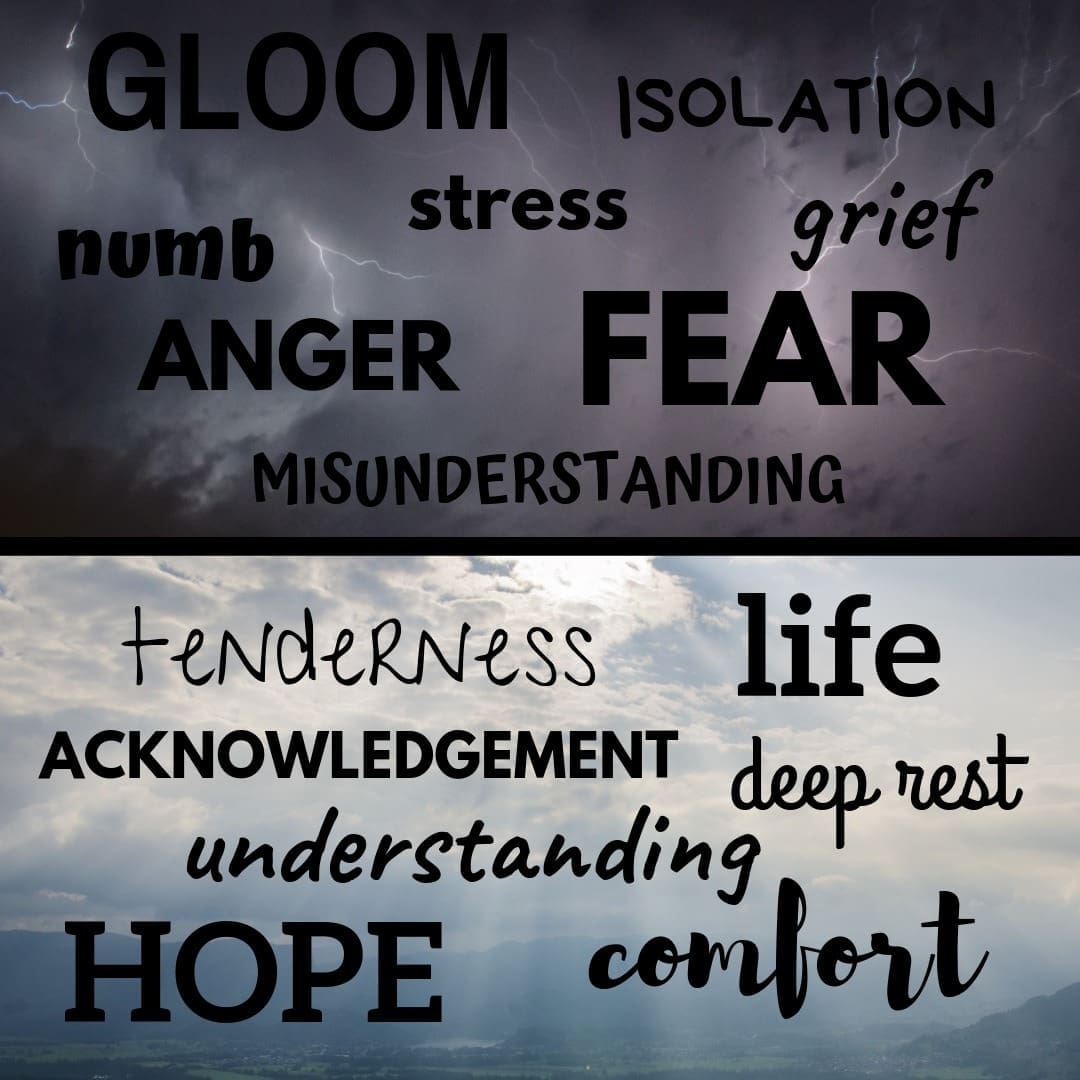
You can take this very moment to check in with yourself about what you are feeling today. Look at the list on this post’s graphic. Do any of these resonated with you today? If not, what word better describes your experience of this moment?
Do you get frustrated with physical changes or limitations after treatment for cancer?
Do “limitations” leave you feeling diminished?
As humans, we all face physical limitations related to being mortal and facing our own mortality is a realization that brings all kinds of feelings – fear, grief, anger, denial, acceptance. But just as we must face certain limitations related to our human existence, there is also the potential for limitless possibility.
How do we move through the world and keep taking action once we are so aware of our limitations, vulnerabilities and imperfections?
“The first way that I think about it is through my public health work. It’s about the idea that we’re all so incredibly limited and yet there are ways that we string together and are almost unlimited as groups of people. It’s magic when that happens- when you all start pulling together and then you eradicate polio from the world, which we’re almost on the verge of doing.”
I love this wisdom from Dr. Atul Gawande where he describes how connection and community create a synergistic effect that give us the feeling of growth and possibility, where creativity and new ideas emerge, and where we keep each other motivated and accountable to our missions in life. This is when the seemingly impossible can happen. The point here is that as humans we are are all indeed imperfect, limited and uncertain of the future. When we lack connection we feel alone and more limited, but among a healthy community, we can help each other grow, expand, and heal.
In my Healing Well Course, we explore Principle #4: Finding the Gifts in Limitations. For some people, the cancer experience is the first time you find you can’t push past your limitations caused by illness or treatments. You are given an unavoidable opportunity to discover the potential gifts of limitations. How can you work with your limitations to benefit and even enhance your life? Are there family or friends with whom you need to practice setting healthy limits to prioritize your own healing?
For deeper healing to happen, to push beyond our limitations, I believe community is essential! I’m leading a free 40 day meditation challenge, a challenge by CHOICE and INSPIRATION, NOT obligation. You can participate as much or as little as you like and start anytime. Doing meditation in a supportive community and also taking the Healing Well Course are great ways to move beyond real and perceive limitations created by the “new normal.” I hope you’ll join us in the free 40 day meditation challenge here.
What if doing it together beats doing it alone? For deeper healing to happen,
I believe community is needed!
You are cordially invited to a daily meditation to take you through the Holiday season and beyond.
Yesterday, I was thinking about WHY I’m so attracted to group work even though I’m a MAJOR introvert. It’s because being part of an ongoing group means you get to cut through the small talk and get down to what you are really thinking and feeling. You can give and receive energy and support.
I was also thinking about my life and how off balance I have felt in 2019. I came to the same conclusion I always do: daily meditation practice is essential. It enhances my daily life, mental health and physical wellbeing.
With the topics of community and daily meditation on my mind, I taught my Wednesday Wellness Yoga class today where one woman shared how hard it is to do the practices on her own.
Practice IS hard to do on your own. There are SO many distractions. Creating space for yourself can be hard.
Someone else said she was setting an intention to “let the universe in” to a difficult situation that she knows she can’t control. As cancer survivors, we are all familiar with feeling like things are beyond our personal control.
And so as the class was lying in sivasana, I decided to initiate a 40 day community meditation. The class had a very positive response! And we’d love you to join in.
We are going to challenge each other to participate in a 40 day meditation. This is a challenge by CHOICE and INSPIRATION, NOT obligation. You can participate as much or as little as you like and start anytime. It’s completely free.
How will it work?
1.Each day, STARTING TODAY (or whenever you open this email), you are invited to begin and continue during the 40 day period as often as you can. Daily if possible!
If you decide to participate even for one day, reply to thisemail so I know to include you in the Facebook group (email and Facebook name) or in a group text if you don’t like Facebook (phone number and name)
2.We are going to be using the RA MA DA SA Sa Say So HUNG Meditation from the Kundalini Yoga tradition. This meditation is for healing through compassion and being open to miracles to work in your life – in other words, allowing the Universe in! The meditation is simple and melodic.
3.Suggested times for meditation: 3,7, or 11 minutes up to 31 minutes. You can set a timer.
4.You could also simply have the mantra playing as you work, drive or sleep.
Sit for a few moments/minutes afterward and practice inviting the Universe in. Be open to healing and offer yourself compassion.
Step Four
Say “Sat Nam” to honor your True Self.
Step Five
If you wish, share in the facebook group or text that you completed your practice for the day. You can write up to a sentence or more or simply say “did it!” When you share that you have done your practice, you will inspire and remind others.
Step Six
Be kind to yourself. If you forget, just start again. If it’s not right for you, that’s ok!
Step Seven
Invite your friends. Anyone can join. The more the merrier!
This mantra taps into the energies of the sun, moon, earth, and the Infinite Spirit to bring deep healing. It is important to pull the navel point powerfully on the first Sa and on Hung. Note that the word Hung is not long and drawn out. Rather, it is clipped off forcefully as you pull in the navel. Chant one complete cycle of the entire mantra with each breath. Then deeply inhale and repeat. Remember to move the mouth precisely with each sound. Try to feel the resonance in the mouth and in the sinus area.
Mental Focus: Healing for yourself or someone else. Letting go of your need to control. Allowing the Infinite in.
Time: Continue chanting for 3, 7, 11 or 31 minutes.
To End: To end the meditation, inhale deeply and hold the breath, as you offer a healing prayer. Visualize the person you wish to heal as being totally healthy, radiant, and strong. See the person completely engulfed in a healing white light and completely healed. Then exhale and inhale deeply again, hold the breath, and offer the same prayer again. Exhale.
To complete, inhale deeply, stretch your arms up high, and vigorously shake out your hands and fingers for several seconds. Keep the arms up and hands shaking as you exhale. Repeat two more times and relax.
From the moment you are born, you need others to survive and thrive. Community lifts you up when you are feeling low. And emotional isolation at a crucial time can be devastating, making a difficult situation feel even more traumatic. We all need community. Even those of us who are introverts by nature or who have an independent spirit.
Community sustained me when I went through cancer the first time. My baby daughter was 2 months old and I was still on a learning curve as a first time mom, sleep deprived, terrified, and furious that my life with my daughter was being hijacked by an urgent need for unwelcome treatments.
Friends brought food and offered a listening ear. Some could connect in spite of my pain and share their own challenges and there were no obstacles to our maintaining friendships. Maria Elena, a yoga friend I met while teaching a program volunteered to help me with my daughter and became our full-time nanny, life saver, and a person very dear to our family and my heart.
As many of you know, I’ve been revisiting the cancer experience personally, this time as a caregiver to my husband. As he continues treatment for colon cancer, I’m aware of how essential community is to me and how hard it can be to ask for help and accept limitations.
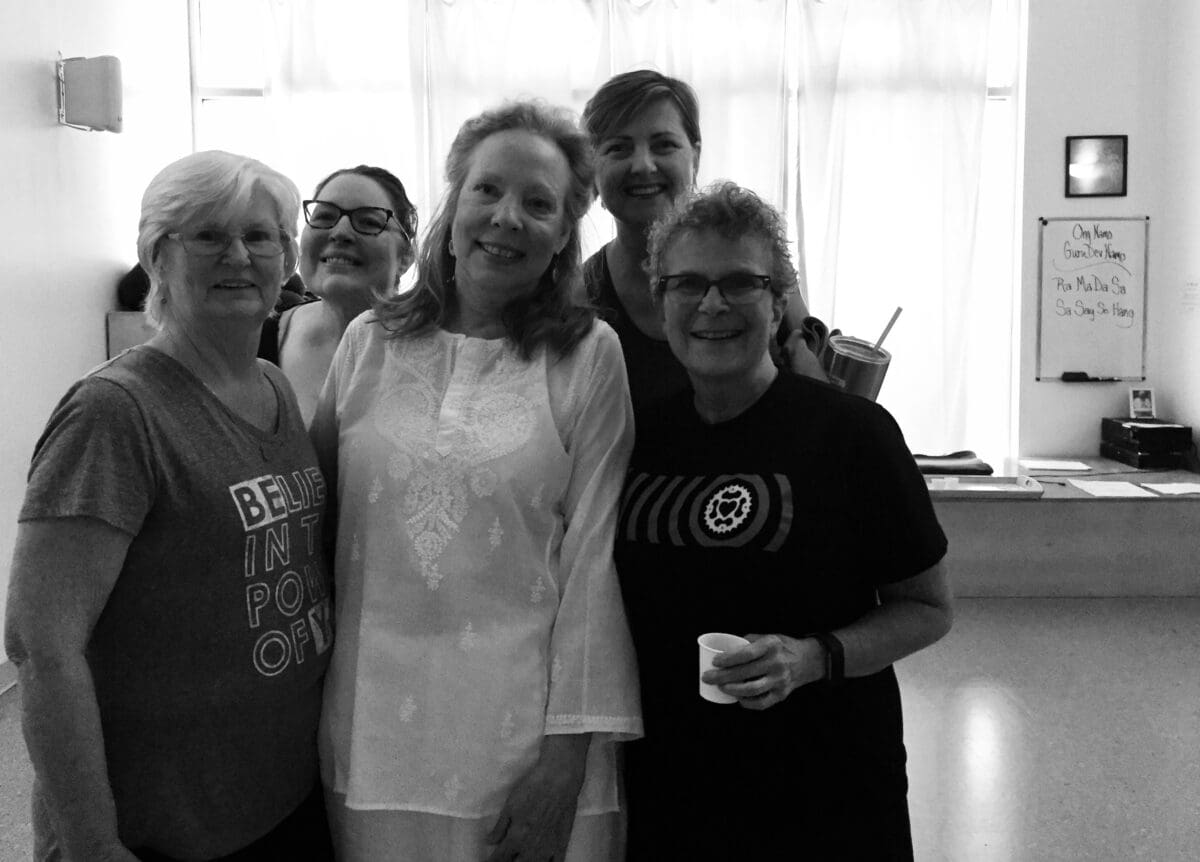
One way I’ve felt sustained by community is connecting with the members of my Wednesday Wellness Warriors yoga class, co-sponsored by Capital of Texas Team Survivor. After a temporary re-location over the summer, we have recently returned to South Austin, in the lovely FlowYoga studio in the Westgate Center.
I’m energized by the enthusiasm and commitment of this group and the way they show up for themselves and each other. I love how large the class is and how many different cancer experiences and stages are represented by this group of smart, caring, capable women, each open to healing in her own way.
I love my connections with the Joybooter community, a fierce and fascinating group of women. Knowing the backstories of so many inspiring women gave me the idea to begin a new series to share some of their wisdom and experience with the larger group.
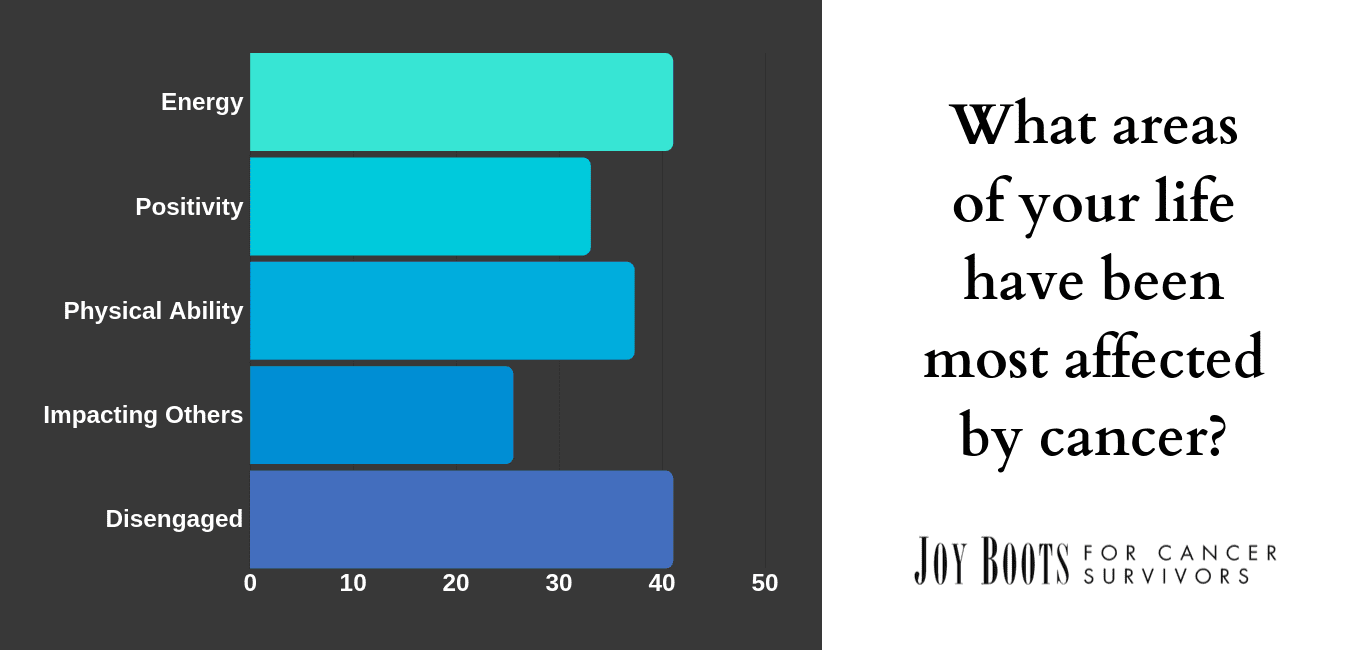
Last week, I highlighted the top five areas you indicated cancer has most affected your life. But what about the less glaring areas that still very much affect you?
Energy
If you’re undergoing cancer treatment and find your energy is bottomed out no matter how much rest you get, you may be suffering from cancer fatigue. This can last for weeks or even months after treatment ends.
Not eating properly can make it worse. Make sure to nourish your body with the right foods to keep your energy levels up.
Listen to your body when it says enough is enough. Don’t over do it and rest up when you need it. Everything else can wait!
Talk to your doctor about your fatigue if you have symptoms, especially lingering long into recovery.
Positivity
You’ve heard before that your attitude is everything, but the idea of having a positive outlook every day is completely unrealistic. However, an incredibly important part of coping and recovery is to recognize your feelings and emotions.
Seek out therapy to deal with your emotions. Work closely with a professional with the goal of feeling more upbeat, seeing the positive and having a better quality of life.
Sadness, depression, guilt, fear and anxiety are all normal parts of having cancer and recovering from cancer. If you need someone to talk to, email me or reach out to one of your fellow Joybooters who can relate. Find support wherever and however you’re comfortable.
Acknowledge your feelings and then take control over them before they take control over you. When you’re in a slump, take a walk, watch funny videos online, look through family photos– whatever removes you from the present moment and propels you into a happier, more positive one.
Physical Ability
Depending on the type of cancer you have, your overall health and where you are in your treatment, you may suffer from physical limitations or even lasting physical side effects from cancer. Respect your physical boundaries, but also keep in mind the positive effects that exercise has on your physical body, your mood and your spirit.
Too much downtime can lead to loss of function, muscle weakness, reduced range of motion, blood clots and fatigue, so do any amount of exercise you’re comfortable with that doesn’t cause too much pain or discomfort.
Stay as active and as fit as possible by finding activities you enjoy or even trying new, lower impact ones like yoga, dancing or swimming.
Just like before cancer, physical activity in your daily life is essential to your long term health. Staying active, even if you’re only able to take short walks, will help you in recovery and beyond when dealing with the lasting side effects.
Impacting Others
Cancer will affect other people besides you. Your loved ones will likely experience much of the same fear and sadness as you. You may find yourself relying on others more than you’re comfortable out of necessity. Sometimes people may distance themselves from you.
The stress of diagnosis, treatment and recovery can be hard on a marriage or committed relationship. Know that you are not alone in this. Consider reaching out for support from a marriage counselor or individual therapist.
Some people may not have the capacity to be a friend to you during this time. This can be painful. Try not to blame yourself for this.
You may find that people you barely knew become important parts of your life and that you are better for getting to know them. Be willing to risk connecting with new people through support groups and other healthy activities.
Feeling Disengaged
You may feel disconnected from your life before cancer, your job before cancer, your friends before cancer or your interests before cancer. At times, you may feel completely disconnected from the past and disengaged from the present. Or sometimes you may feel down for no particular reason at all.
Whether it’s a spouse, sibling, parent, friend, fellow Joybooter or professional– get support from those who care about your happiness and your mental wellbeing.
Being disengaged from life and from the things that would typically bring you joy can manifest into depression if not treated. Talk to your doctor if you have feelings of depression that lasts for more than a few days.
As you reach the end of active treatment or a plateau, you may begin to re-assess your goals and priorities to find that they have shifted, sometimes dramatically, both from necessity or by choice.
How can you move forward even as you continue to heal? In my own recovery, I needed to create a new framework for my healing. In working with survivors, I developed 6 Principles for Emotional Recovery that I have found helpful to share.
This fall, I’m again offering my 6 week online course: Healing Well:Reconnect to Your Life After Cancer. While these principles truly apply to everyone, I love sharing them with my fellow JoyBooters.
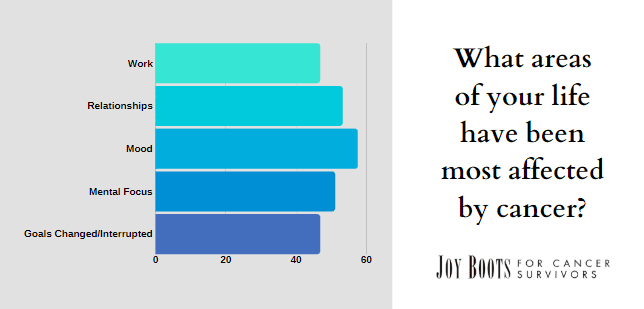
Thanks to everyone who shared their feedback in last week’s survey, Impact of Cancer Experience. It’s no secret that cancer impacts everyone in different ways, but I wanted to share the top five areas that were revealed by the survey results and share some ideas to help you address and cope with the different scenarios that may be impacting you wherever you are in your journey. .
Work – You’ll need to figure out how and if you will continue to work while you are being treated for cancer. Here are some tips to help you better manage your work life.
Set limits and realistic expectations with management, being clear about when and to what extent you will be taking time off or returning to work.
Don’t take on any extra responsibilities at work. This will further deplete your energy and add stress to what may feel more demanding than it once was.
Familiarize yourself with your employer’s leave and illness policies so you can make informed decisions about taking time off.
Find allies in the workplace and educate co-workers who you can trust to support you.
Give yourself time to recover. Find ways to breathe and relax, if you can, during the day.
Sometimes people find that they choose to return to work too quickly. If you can manage it, consider giving yourself a slow re-entry (i.e. returning less than full-time at first).
Relationships – Cancer can impact many things in your life, including your friendships, family life and marriage.
The stress of diagnosis, treatment and recovery can be hard on a marriage or committed relationship. Know that you are not alone in this. Consider reaching out for support from a marriage counselor or individual therapist.
Some people may not have the capacity to be a friend to you during this time. This can be painful. Try not to blame yourself for this.
You may find that people you barely knew become important parts of your life and that you are better for getting to know them.
Be willing to risk connecting with new people through support groups and other healthy activities.
Mood – A cancer diagnosis is a life-changing event which will undoubtedly affect your mood and it’s important to take notice of these fluctuations.
Know that shock, stress, grief, anger, fear and even terror are normal responses to the cancer experience. Know that these are not permanent states and will eventually pass.
Be open to allowing the experience to impact you instead of fighting to pretend everything is exactly the same as before. This will free you to not stuff your feelings and reach out for support.
Let your loved ones know how you are really feeling, if it’s emotionally safe to do so. Allow people to comfort you and to be with you in the struggle of what you are feeling.
Support groups can be VERY helpful for many people. Seek them out in person and online.
Make use of activities such as exercise, yoga, meditation, bodywork. Choose activities that bring pleasure to your body at a time when you may be feeling physical and emotional discomfort.
Find a good therapist and share.
If you are unable to find relief and/or worry that you might hurt yourself, please seek a consultation with a psychiatrist or therapist immediately. You are going through a lot and deserve all the support you can access.
Enjoy the moments of gratitude and contentment and appreciation that can be a part of your experience. Know that these are not permanent and don’t try to hold on to them. They will come again.
Mental Focus – Cancer treatments may cause cognitive symptoms such as a shortened attention span, difficulty thinking and short-term memory. (“cancer brain” or “chemo brain”).
Give yourself time to rest and recover.
Know that most cognitive challenges will improve once treatment ends.
Practice self compassion and patience with yourself and the process.
Find support groups.
Try meditation to improve memory and lower stress, anxiety, and and inflammation.
Even if your memory or executive functioning does not return to pre treatment standards (mine didn’t!), you are still a worthwhile person. Practice acceptance of how things are now. Get support for this if you need to-it’s hard!
Practice enjoying being “in the moment!”
How your goals and priorities may change and evolve-coming up next week.
Whether you are a cancer survivor, loved one, or oncology professional, there’s still time to let your voice be heard in the survey:
As I shared last week, I learn so much from you and your experiences. Whether you are also a cancer survivor, a loved one, or an oncology professional, could you do me a quick favor?
I’m about to offer my Healing Well: Reconnect with Your Life After Cancer course again and could use some feedback before I finish it up.
Would you be able to help me by answering a few quick questions based on your own hard earned experience? It should take 1-2 minutes): https://www.surveymonkey.com/r/NYLHP8B
“You have given me the strength to carry on and find happiness and light.” Suzanne Cowper
Sometimes people ask me why I want to work with cancer survivors. They wonder why it doesn’t bring me down. It may seem strange, but I usually have the opposite feeling from my work with people faced with cancer or those who have been through treatment.
I generally feel so uplifted and encouraged by the strength of the human spirit, the poignancy, the depth and the humanness we all share. I also like being with people who can deeply understand what it’s like to consciously face their own mortality and carry on, even while living a day to day existence. I get to see people experience the whole range of normal human emotions– the
shock, the fear, the anger, the ecstatic experience of the present moment, the appreciation and gratitude for the gift of life and their blessings. I get to see immense courage which always includes such touching vulnerability.
All these experiences that people have, they bring with them to the yoga mat and to counseling sessions and I get to be inspired by their courage and touched by their vulnerability. I’m deeply moved by the common humanity we share and the different stages of emotional shock, anger, fear, gratitude and wonder we all experience. I get to witness and share in people’s moments of awareness and healing no matter what is happening with the cancer in their bodies.
I had a friend who came with me often to chemo. Her prayer with me as we would begin the treatments was “Thank you for this breath. Thank you for this moment.” I hold this with me today as the highest prayer, simply to be present and aware and show gratitude for this moment, right here, right now. True healing is not the same as cure. Cure is something else. To me, healing is about coming in to reality and accepting it while maintaining appreciation of the gift of this present moment.
When faced with a life-threatening illness which draws you into a confrontation with your own physical vulnerability and mortality, your system is awakened. First, you are in shock, but then you remain very alert. You are alert to your fear, the side effects, ideas of the future, the urgency to take action, your desire to protect loved ones. More than ever, you have the opportunity to be very alert and sensitive to what is most important.
I want to be around people who have been awakened. I want to surround myself with those who, even though they would not have chosen this path, are using this path to connect to their own hearts and pulse of life. The people I’m drawn to are those who have the undeniable strength to carry on, seek happiness and light even when rummaging around in the darkness of difficult moments.
So many people have reached out to me during my husband’s illness with love, encouragement and deep understanding. They have shared their own experiences of surgery and treatment with great advice and deep empathy for my husband and me. I learn so much from the Joybooters who come to my classes and groups. I get as much energy as I give and learn at least as much as I teach from the brilliant minds and warm hearts I am connected to.